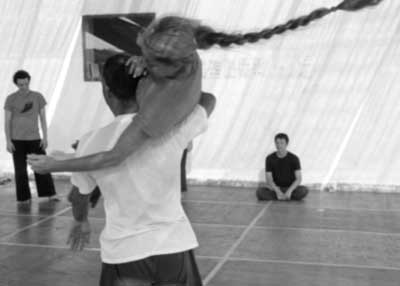
Photo by Tinu Hettich of Nancy Stark Smith dancing with Franco Zita during her workshop - ZOOM: contact improvisation in detail and perspective - at Casina Settarte in Cisternino, Italy
Edited by Ann-maree Ellis
Hellene Gronda interviewed Nancy Stark Smith back in 2000, when Nancy was in Melbourne to teach a 2-week Contact intensive, “Deepening the Form”. An opportunity I regret missing. However, Hellene has allowed me the pleasure of editing this interview for <Proximity>, and I’m dancing better already! I’m only sorry to have had to withhold so many gems from the interview, but there wouldn’t have been room for anything else in this issue.
Photo by Tinu Hettich of Nancy Stark Smith dancing with Franco Zita during her workshop - ZOOM: contact
improvisation in detail and perspective - at Casina Settarte in Cisternino, Italy
Hellene Gronda: One big area which interests me is risk. Mainly the physical risk because you’re falling and it is improvised. I feel this element of risk is a really important part of the practice.
Nancy Stark Smith: The fact that the dancing is
improvised and that falling is part of it, I feel
actually makes it safer. Because you can work with
your off-balance states and activities rather than
trying to pull everything on balance as with most
other dance forms where you’re wrong if you’re off
balance and you try to strain to stay on balance;
Contact asks for a different kind of balance.
But when you’re learning how to fall, you can go
with the fall, and follow it through and come up and
everything’s fine. So you are actually learning how
to follow through various kinds of forces, including
gravity, safely. And if you’re a little bit off and you
land on a joint oddly, you can turn it and roll, and
follow it through rather than trying to hold on to
positions that are actually very unstable. So in a
way it’s safer for your joints.
The other part of it for me has to do with alertness -
the fact that you’re not sure exactly how it is going to
work out, and that it is dangerous to the degree that
if you don’t pay attention, you could be injured. If
you do pay attention you can follow it and deal with
it. It might not be the most beautiful solution in the
world, but it will be safe, generally, because as you
train, your instincts get better at knowing how to
follow these things rather than resist them.
We breed in a lot of defensive behaviour for our
bodies because we’re not falling regularly or
working with these forces.
Some of those habitual defenses that are more
fear than anything else – like sticking your arms
out straight and locking your elbows to stop
yourself on the floor, rather than to reach for the
floor and slide or roll, to try and stop it from
coming rather than to come towards it and follow
it through – those do change as people train.
They get used to feeling their body with gravity
and support coming from different directions, from
the back and side and so on. So the instinct to
soften and reach for something and slide, or to
touch it lightly and then go further or something
like that, is kind of re-trained into the body
through Contact practice.
But I do think that the risk factor of being offbalance
or falling wakes people up and keeps
them awake a lot of the time. That is part of the
benefit of the practice it seems, to keep people
awake and focused on the present. And then
they feel more fully engaged with their body, with
their mind, with each other. And that’s a very
pleasant feeling, it seems.
Yes, I think that’s how the risk factor interests me. And then arises the paradox of why aren’t we awake? Why do we have to arrive into sensation? Certainly there are psychological, cultural answers in any specific case, but I wonder if there is something more universal about awakeness?
Well, I don’t know about universal. I can only
speak from my own experience of being in a body
and working with people. But it seems that our
culture and our lives prepare us to be awake to
certain things. So we get kind of trained in certain
ways, consciously or unconsciously about what
we’re looking for, what we want, or are afraid of,
what we’re used to.
And… the degree to which we are aware of our
physical sensations probably has to do with
survival, also. What do we need to know? If
something is hurting you your body will tell you and
you’ll move away from it. On the other hand people
wear all kinds of uncomfortable clothing because
they look good… But it doesn’t bother them
because they are compensated for by this other
aspect. The shoes that they’ll squeeze themselves
into – it’s sort of fun rather than painful because it
is toward an end that they want.
So I think that we’re incredibly flexible machines in
what we pay attention to and why, and how we
learn or adapt to different kinds of focuses.
If you need to feel very fine gradations of gravity in
order to read your partner’s movements more
closely, in order to balance with them, or get
support from them, or follow through something
successfully so that you can take the fall together,
or so you can support the weight successfully
without hurting yourself, or transition then the more
sensitized you will become to these small
gradations of change in the body.
And then in the meanwhile you realise that you
actually, emotionally and psychologically feel better.
You feel clearer, because you’ve focused on this
task and a lot of your other worries or things that
you’ve been doing during the day suddenly have
disappeared and you think, “oh what happened? I
guess I really like doing this activity.” And maybe
you like doing the activity because you get
compression and touch and you’re dancing and
flying and doing all these things that feel good. But
you might also like it just because it clears your
mind of these other things that are cluttering it
during the day and you feel free of...
Is it a meditation practice?
Well, I think because it asks you to focus initially
on, let’s say the touch with your partner, the point
of contact, in order to be able to keep balancing
with it and have it roll or pass across the surface of
your body so that you two are staying in touch, you
have to concentrate on it. Otherwise it’s slipping
and falling off and you’re off and you’re on, and the
smooth continuity of that touch – which is one
model for it, it’s not the only one, but it is one of the
basic practices of how to stay in physical contact as
your body is turning and changing, and changing
levels – that requires concentration… to the touch.
Because if you’re feeling it here, and you’re
adjusting your body so you can touch and
balance… and then suddenly you start thinking about what you’re going to have for dinner, before
you know it, you’ve lost balance with your partner.
You’re falling out of balance and you’re not
touching any more. That loss of touch is a physical
stimulation that tells you “oh, I lost it.” And then you
retune your focus mentally and physically and then
you regain it, the present contact.
And so it is a meditation practice in the sense that it
is asking you to focus your mind on your body, on
sensation rather than following some other idea or
feeling. So it keeps bringing you back to your
physical sensation, synchronising your body and
your mind and time somehow, because it is in the
present moment that they’re both meeting…
achieving that kind of synch.
It is also synchronising both of our attention, on
each other. On sensation in the present
moment. So, there are a lot of things that are
helping us to connect.
As I’ve been learning Contact, the sense that if I lose concentration I’ll fall and hurt myself was a real key for me in my learning. It was a support for the activity because since the rest of my daily life is about a different kind of attention, I seemed to need quite a serious message: “if you don’t be in your body now you could end up with an injury that you’ll then have to carry and deal with”. It was like a support or a permission to focus on my body. So I liked something you said about limitations, about respecting bodily limitations and pulling back before you reach the limit, and using body awareness as a guide for that.
Right, and to try and back it up a little bit so that you can redirect the flow of movement away from danger, rather than having to wait until the movement hits the limit and then realising, “oh I can’t go any further in that direction.” You are keyed in enough to your body sensation that you can feel the direction a movement is going, and you can feel your joint or your muscle coming to its limit. You can feel it arriving at its limit. So rather than only feeling it when you’ve hit the limit you can start to feel it as it arrives at its limit. It’s almost like a sound, or a tonality in the body. You can feel how it is almost reaching its limit, and you can measure that and redirect the flow of movement out of that direction, even just slightly. You don’t have to reverse it, you can just go a little bit to the right or the left and relieve whatever impending limit you were headed for so you can continue to dance.
How do you think you learn that? Obviously all the Contact training, but it seems like that’s quite a high level of bodily integration…
It is but we do it… It’s survival I think. We do it all the time. Part of it is visual, like you see the door jam, and you duck. You’re trained to see obstacles and to avoid them, unless you’re not paying attention. But I think also people who have practiced a lot of Contact… A friend wrote that Contact is sort of like walking on very uneven terrain. That your ankles and feet get a chance if you’re walking on very bumpy terrain, they expect to have to adjust. Whereas if you’re walking in a dance studio or something, you almost lose the ability to adjust because you’re assuming that everything is going to stay even. And in Contact you’re confronted with a situation every moment, of change, so it stimulates you to be adaptable. And that also is a very freeing feeling. Rather than your range getting smaller and smaller because you need to stay more stable because you’re not flexible any more mentally or physically, instead it goes the other direction: you become more flexible, more responsive and freer, you could say you’ve got more range.
Yeah, I heard of some research that links Western backpain to the fact that we walk on concrete surfaces all the time. The body is actually designed to have more range. On that point about range of movement and freedom… the two weeks have redefined what I mean by Contact Improvisation in terms of the freedom to improvise. But I’m not even totally sure what that means. After all it is an attention practice of following, so where does improvising come in? Where does it shift? Sometimes it seems Contact is only about following the forces, and the flow of weight but there’s this other element about freedom.
Well, there are many choices to make as you
follow, as you are dialoguing with the forces. You
can resist them: that’s one way of dialoguing with
them. Your partner gives you a little extra weight
and you can choose to match it and balance, or
carry it somewhere, or… you can respond in a lot
of different ways. Just like if you speak English
with someone, you start a conversation, and you
listen and you respond in the way that you want to.
So even though you have a certain vocabulary, and
mouth structure and ears and all of that and how
loud you speak, or where you are, what context,
how private it is… there are so many conditions
that affect the choices that you make.
And likewise in dancing. We’re trying to be
sensitive to the physical forces that govern our
movement, and with that sensitivity we can have
more choices about how we respond. So we’re
not always at the point of absolute survival
where there’s only one choice – and that isn’t
true either – there are a lot of creative solutions
to even a dire survival situation. But there are
choices to be made.
And that’s where I think the teaching of technique
and skills can be misunderstood. If you learn how
to roll or fall safely, or slide or any of these things:
they are to give you more options as you proceed.
But you can misunderstand that and think, “oh the
point of this is for me to get better at this one thing;
to always do it in the perfect way when I am
confronted with this situation.” So then you go
towards a kind of virtuosity – and virtuosity in itself
is not a problem. But it shouldn’t be at the expense
of your choice-making. And it isn’t, ultimately. The
more virtuosic you get, the more choices you
should be able to have in responding to a given
situation. So that’s where the dialogue comes in,
that’s where the improvisation comes in.
It’s not that I’m improvising because I have no
choice, because I don’t have any skills, and I’m just
sort of falling into this situation and whatever happens because of the forces, I’m at the mercy of
it… But I start to have a relationship with it. So I
can hear your weight coming, so to speak. And I
can… take it in… I can feel my response. I can
feel my limits, what I can do, and how I can
respond. “No, I can’t do that. Well within the range
of what I can do, I can go left or right, or I can go
slow or fast.” You start improvising and there are
many different responses to have.
That’s why I think it is dangerous to offer too many
skills too specifically, as opposed to offering them
as principles. And not necessarily saying “put your
hand on this part and then do this and then do
that…” Instead, you say “Yes, you can do that.
And this is a bit of physical vocabulary you can try.”
And maybe it will bring you into an experience of
a movement you wouldn’t have risked otherwise,
because you were so disorientated in that
territory you wouldn’t have tried it. But let me
orient you and say, put your hand here, feel for
that – get the rhythm of this, and the other person
does this… and then suddenly you’re doing
something you never would have done before
and you feel safe in it. But then you want to
decode that so that you understand what the
principle is. And then you can deconstruct it and
reconstruct it in other situations that you choose.
Or, forget it entirely and invent a new kind of way
of being in dialogue with the forces, invent a new
texture, invent a new permutation, or structure.
And keep the improvisational aspect of it alive.
I really enjoyed getting a deeper sense of that. I still wonder though at this balance between an idea of intentional choice by someone who would actually feel free. There is definitely a part of me that feels free in it, but then on the other hand I wonder about how much control I actually have. Some of the best moments have been finding my body responding reflexively, in a way I didn’t think it could and getting the most amazing ride. And that’s also a way of dealing with fear – by trusting that that will happen. Steve Paxton writes something about this in the Sourcebook where he talks about the meditation practice, about making consciousness observe rather than dictate. And I think there’s a really interesting reconfiguration of intention in this practice.
Yes. I think it also flickers between, because
there’s a lot of reflexive activity going on because
you’re stimulating the body to feel danger in that
way. You’re going past … you’re coming right up to
the edge of control. And that’s different for different
people. I might look much further off centre than
someone who is just learning how to fall and feel
that it is ok to be in a fluid state around balancing.
Rather than balanced stability and trying to maintain
that at all costs, there are the small movements
inside balancing and then the bigger movements
inside the sphere where gravity is starting to take
you off balance, so you can follow that and redirect
it in different ways and get a ride out of it. Like
learning how far off balance is going to make it
completely out of control for you and dangerous?
So that exercise we did where you were tipping
backwards, and you would catch yourself? You can
start to control how far out of control you’re getting. I think actually in this dance form, now that we’re
talking about it, I see that there are a lot of levels of
intelligence being called into play. There’s reflexive
bodily intelligence. There’s instinct. There is
awareness, or consciousness. And there is also
choice and decision.
Sometimes I use the image of “the third mind” – the
idea that when there are two people meeting, to
work on something, to collaborate, there’s this path
which is a function of the two of them together, but
neither one of them independently. The third mind
is this path that emerges from the two people
focusing toward one another and releasing
excessive control over the situation, but also not
abdicating responsibility for the whole thing. So
you’re right there in the middle.
One way to check it might be to say “if you think
you’re leading, stop leading”, so both people think
they are following. But on the other hand I think
you can become too passive, then the thing isn’t
happening either. So you’re somewhere between
leading and being passive. And that’s a very
curious state. And I don’t think it is just one
condition. I think that sometimes there’s a moment
where you do take a decision. Maybe because
your body is reaching a limit and you have to
communicate to your partner – “no I can’t go any
further in this direction. So I’m going to suggest,
within the flow of this, how about a bit to the left?”
And maybe my partner can’t go to the left, and
they communicate back “no, not to the left” and I
have to try “how about to the right?” because I
can’t go straight ahead. And all this is happening
very quickly! So we don’t always know when the
activity is being slightly redirected, whether it’s
because of the physical limitation, or a habit, or a
desire or a reflex, or what’s going on. It’s a very
interesting thing when you’re talking about two
people collaborating on the direction of something
that’s so physical.
So the activity of Contact Improvisation seems, in
this holographic way that we’ve talked about, to be
many things at the same time. It is engaging our
intelligence on a lot of different levels.
And in the way that it is a conversation, it is not the
same as a verbal conversation in that generally
speaking, one listens and then one speaks,
sequentially. But in Contact Improvisation it is at
the same time: you are speaking and your
response is a form of speech, is a statement in
itself. So if you ask, when am I speaking and when
am I responding? They are happening at the same
time, very often. Sometimes it is more one than the
other, but they are always mixed in. Obviously
there’s a lot of study one can do about how the
body works. But in a general way, one can say
that it is functioning on a lot of different levels at
once. It is speaking and listening at the same time.
It is motor and sensory at the same time. It is
leading and following at the same time.
And the activity is a practice of all of those things. It doesn’t actually require that you necessarily sort them out.
No, but perhaps it is one of the reasons why people feel exhilarated or notably alive after practicing it. They feel that their senses are sharpened, that they’re … there’s a feeling of being very dimensionally… activated so that you’re both able to receive and be active, not just one or the other.
The idea of the dance as conversation brings up the issue of meaning. One of the seemingly obvious differences from a verbal conversation is that you’re not meaning something when you dance in the same way that you are trying to mean something when you speak. But that seems almost too easy in a way because so much meaning does come out of the experience of dancing. And perhaps this is related to what you were saying about “metaphorising.” The way Contact Improvisation becomes such a useful metaphor for, well, everything. It seems to be so easily a source of metaphors.
Well, it can be. Because it is a specific activity: about meeting or balancing or improvising with physical forces and principles. Let’s say the principle is leverage. Leverage is a very physical thing. If I put a fulcrum under something, I push down over here and I get that to move up over there. So if you’re going to use leverage as an idea – like this gives me leverage in my relationship to so and so because I have this to offer… you know, whatever it is – the fact that there is such a thing as leverage, that it is a physical principle, allows you to refer to it in other ways. If it was a very generalised thing then it wouldn’t have the same meaning when you used it in another context. It would just mean maybe, influence, but it wouldn’t be a specific kind of influence like leverage is. Or ballast. Ballast is a kind of leverage like in a ship. If you can put a lot of weight on that side then I can lean further on this side. So if that principle of putting more weight on something in the opposite direction so that I can go further in this direction and it will balance itself out, if that principle is clear then I can use it when I’m talking about something else, as a metaphor. But if I don’t really know what specific force I’m talking about then it’s a very generalised use of that term. To use physical forces as a metaphor you need to know them well.
In contact it feels like you’re getting to understand and then use these principles experientially, not just as ideas.
Yes, a big part of what you’re learning in Contact Improvisation is the nature of the forces. So it’s not about just achieving a certain shape, but about reading the forces. And so as you get better at reading the rise and fall of weight, and the placement of centre and the structural support and the timing of the transfer, and all of these principles of how it works… like if I’m going to put my weight over your skeleton directly, instead of on the periphery or on the edge, I make it easier for you to lift me because I’m using your structure more efficiently. The same way I can use my structure more efficiently. So as I learn the structure of my body and how it works in the gravity system and momentum… you know we did that lift where you support someone in the direction they’re already going up, and then you start to turn? And by turning the momentum and the centrifugal force of the turn supports their weight as well as your activity. You’re just learning how to work with the forces so they become at your service. And then it takes less effort. As you feel these re-combinations – on the way down I can do this, on the way up I can… and every dance that you have adds more information to that sort of bank of knowledge, experiential knowledge. You have a little bit of idea thrown in – your teacher says notice this, notice that. But really, you’re experiencing a lot of variations on it and your body says “ooh why was that so easy? And wow, how did that happen?” And you only know it a little bit and you experience it a lot. And so your body starts learning from its experience, not just from the ideas. But it is a combination.
You said earlier that you can only dialogue once you know the language, so you can be in relationship to the forces…
But it works both ways, it’s not that you have to know what the forces are before you start dialoguing with them. Something can happen accidentally and you’re relaxed and you’re working with it and you think, wow – how did that work?
Oh that’s great because the paradox is that you are in the forces anyway, you’re using them, your body is using them. So it’s funny that you train to learn to use them, since you are already in them anyway.
Yes, it is a paradox. And then certain ones are revealed to you, perhaps by accident, or perhaps by experience of your partner, that you didn’t know existed. There’s a lot of unconscious learning going on. And then at various moments you become aware of it. So, on the meditation level you’re being led into a certain state of awareness: of relaxation and awareness. And then you’re just… setting the thing in motion and seeing what your body-mind learns from it and then passing that on to the next person that you dance with. And then there’s always new puzzles. And that’s what keeps the learning going. So you’re not just perfecting what you already know, but you’re also finding… it’s about learning.
Is that an opportunity that you give yourself? In the situation, I may think I know everything but you give yourself the opportunity not to know.
Hopefully. That is how you learn. And I guess there might be people who teach or study this just as a way to get good at certain things. But the fact is that the form is practiced in duet. That it is an open form, in the sense that you should be able to do it with anybody else who speaks that language. And every individual that you’re going to encounter has not only their own particular body but their own body of experience. So they’ve experienced different kinds of approaches and follow-throughs and sequencing and everything else and they’re kind of putting them up against yours. And in order for you to be able to dance together you have to adapt to one another, and so you learn. That’s why it seems like such a healthy and provocative thing to dance with people you’ve never danced with before, and that’s why people go to Jams in different places in order to stimulate their learning.
That’s a question of practicing, isn’t it, because dancing with people you know builds up a certain kind of trust.
Right, which you also want. And on the basis of that confidence and comfort you’ll explore other risks. So that’s definitely a positive thing. But then you find yourself in a lot of habits with certain people that you dance with all the time. And just sort of flowing along those well grooved pathways, you’re going to start feeling maybe a little dull, and wondering how to stimulate a feeling of freshness in it.
I was really surprised when you said at that conference: “you can’t talk too much about it”. Obviously you are involved in Contact Quarterly and writing about it, but I was surprised, because often in these body-mind practices there’s an attitude that talking about it reduces it somehow.
Well I feel that there are some points in one’s
experience when it’s premature to try and articulate
certain things. And if you’re forced to, it just is a
little premature and it’s a strain. I don’t think it’s
going to hurt anything that much. But I do think a
balance is useful, of study and practice. And study
on an experiential level and on an observing level. Even from the beginning we were making
drawings on pieces of paper about pathways on
the body, and it was playful, but it was
observing and studying and questioning and
bringing other materials to bare. Inventing new
exercises and seeing what worked and what
didn’t. And just experimenting.
I do think that it is possible to get overloaded on
a cognitive level about certain principles or ideas
or intentions, and just become really bogged
down. So the freedom to improvise and be
spontaneous gets a bit stymied. I also think it’s
possible to practice in too unfocused a way.
Ultimately you have to wake up for the reasons
we started out with.
In teaching, every teacher is different in terms of
that balance of play, image, scores, principles,
vocabulary, techniques, talking, time to just let
people dance. Or changing partners: how long
do you let people develop their dance or are you
changing partners a lot? Do you learn how to
change partners but also learn how to develop a
dance? There are lots of different styles. How
much of a performative focus is there?
Sometimes teachers who are naturally moving in
that direction will set up practice situations that
are actually quite performative rather than just
from the practice point of view.
That’s the beauty of the fact that no pedagogy has
been established per se. Each individual teacher
puts themselves into it completely. And though you
might first teach as you were taught, because you
feel more secure about the material that you
learned, you start to realise that it’s arbitrary to
some degree. There are certain things that you
want to teach people who are getting started, some
safety things and some basic principles to get them
oriented. But then you think “oh, today would be a
good day to bring in this thing or to invent
something to get people going because the energy
is low.” And you just have to improvise your
teaching. And then you make up a new exercise,
like one that I had to invent on the spot early on
because I thought, I can’t just show her how to do
Contact and I didn’t have any words for it, so I
invented something that I ended up keeping for a
very long time, as an exercise: the “finger ouija” or
finger-to-finger dance. The teaching is very
creative in that sense, and personalised.
I remember that when I was studying Tibetan
Buddhism, there was a nice combination
between practice and study practices. Doing it,
just putting your butt on the cushion and
following your breath - and your mind would go
off and you’d come back to your breathing, for a
long time, and you’d start to fall asleep and then
you… your legs would start to ache and… you
would just practice. And then other times we’d
read texts or hear teachings at a dharma talk,
and some things I wouldn’t understand that the
teachers were talking about. They were nice
stories, but I didn’t know what they were really
getting at. And maybe two years later, after
practising more, I would understand a little bit
more of what they were getting at with the
stories, but then there’d be other things that I
didn’t understand. That idea of balancing
your experiential practice with your
understanding, your knowledge, seemed like
a really workable way to go. And you can go too far one way or the other but I
think it rights itself. Nothing’s going to go too
wrong. You might just block and say “Oh my god
I just have to forget about this.” Or, maybe the
other way happens and you’ve been just so
soaked in sensation that you need to think about
some thing for a bit!
Well, I just read Christina Svane’s piece, “In Praise of Bad Dancing.” There were a lot of things I liked, but in particular the idea of Contact embracing the fear of itself… she’s talking about being scared to dance or scared to achieve what it is that she is aspiring to. I don’t know, what is your take on that?
Well, I’ve always loved her “In Praise of Bad
Dancing.” I’ve read it a lot over the years to
people, like in Round Robins; when people are
dancing I’ll just read it. I think there is something
very desirable about being in this open state, where
you’re not sure what’s going to happen but you are
present for it. And you’re putting your whole self
into it and you’re finding limitations and you’re…
The potential of feeling this sort of ecstatic freedom
is extremely attractive and I think that the fear of
failing… I mean both fears: the fear of getting what
you want, in a certain way like, could you handle
this? And the fear of not getting it. That’s where
she, you know, brings it around, saying that it’s
time we called it home. “The moments of in tune,
in sync in touch… the moments where you’re riding
the shared wave… these moments are rare.” But
it’s the invitation, the promise of the invitation, that
never leaves us.
What she describes as this ecstatic state, or this “in
sync, in tune, ride of shared energy,” you know that
it’s there. I’m not saying that that is necessarily the
highest order of the dance. The struggling dances
have their beauty, too. It’s very beautiful to stay
committed to something that isn’t working out. And
then you feel the tremendous satisfaction of finding a
way through that mismatch. It’s one thing when you
have a natural rapport or affinity with someone and
as soon you touch them it’s like beautiful and you
don’t even know how you got there. So when you
start with someone and it’s not easy, your rhythms
are not necessarily matching up very well, or your
tonalities or your desire… whether you’re too slow or
fast or are not quite matching up… you have to keep
relaxing to find where you can meet each other.
vol 6 ed 1 - ed 2 - ed 3&4 - 2003 vol 5 ed 1 - ed 2 - ed 3 - ed 4 - 2002 vol 4 ed 1 - ed 2 - ed 3 - ed 4 - 2001 vol 3 ed 1 - ed 2 - ed 3 - ed 4 - 2000 vol 2 ed 1 - ed 2 - ed 3 - ed 4 - 1999 vol 1 ed 1 - ed 2 - ed 3 - ed 4 - 1998 |
e m a i l - <Proximity> |